Research
My research focuses on designing computational algorithms that solve challenging problems in healthcare and communication networks. My work currently spans two research areas: Machine Learning for Healthcare and Satellite-Based Quantum Key Distribution (QKD). Although these areas address different scientific problems, both involve developing intelligent algorithms that analyze complex data, optimize system performance, and support reliable decision making.
Current Research
Machine Learning for Depression Treatment Outcome Prediction
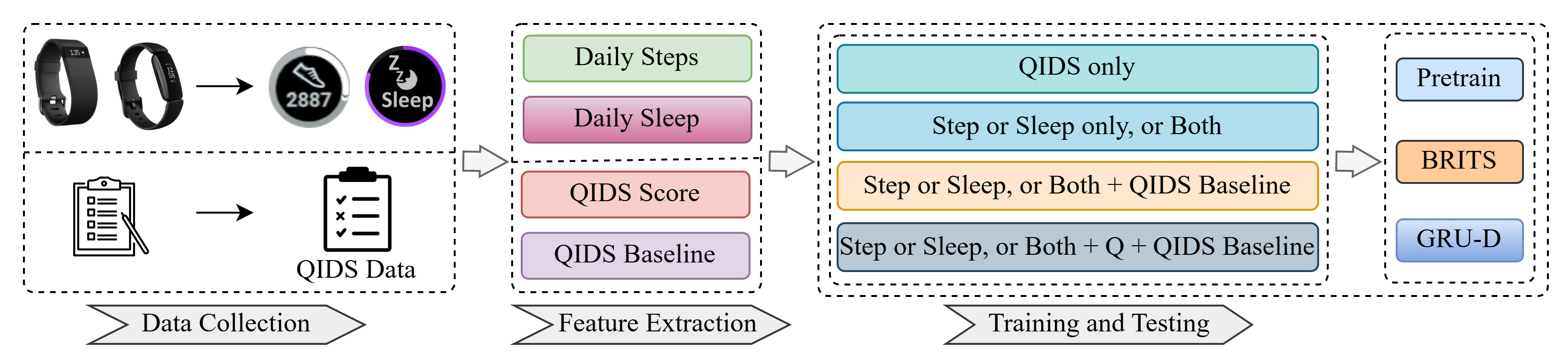
Machine learning framework for predicting depression treatment outcomes from behavioral and clinical data.
Motivation
Depression is one of the most common mental health disorders worldwide, yet predicting whether a patient will respond to treatment remains a major challenge. Traditional clinical assessments usually depend on periodic questionnaires completed during hospital visits. However, a patient’s behavior changes continuously throughout treatment, and these daily changes often contain valuable information about recovery.
Machine learning provides an opportunity to continuously analyze these behavioral changes and assist clinicians by identifying patients who may require additional attention much earlier than traditional assessment methods.
Research Overview
My research develops machine learning methods for predicting depression treatment outcomes using behavioral data. Instead of relying on a single clinical assessment, my models learn from sequential information collected over time.
The behavioral data include daily mood ratings, daily anxiety ratings, physical activity (step counts), smartphone-derived behavioral features, location and mobility patterns, and clinical questionnaire scores.
My current research investigates how different observation windows, including 7-day, 14-day, and 21-day behavioral sequences, influence depression treatment outcome prediction. By comparing these temporal windows, I study the trade-off between making earlier predictions and improving predictive performance with additional behavioral information.
To improve model transparency, I employ Explainable Artificial Intelligence techniques, particularly SHAP, to identify which behavioral features and temporal patterns contribute most to model predictions. These analyses provide interpretable insights that can support clinicians in understanding the factors influencing treatment outcomes.
Research Topics
- Depression Treatment Outcome Prediction
- Longitudinal Time-Series Machine Learning
- Explainable Artificial Intelligence
- Behavioral Health Analytics
- Clinical Decision Support
Selected Publications
Please see the Publications page for papers related to this research area.
Satellite-Based Quantum Key Distribution Networks
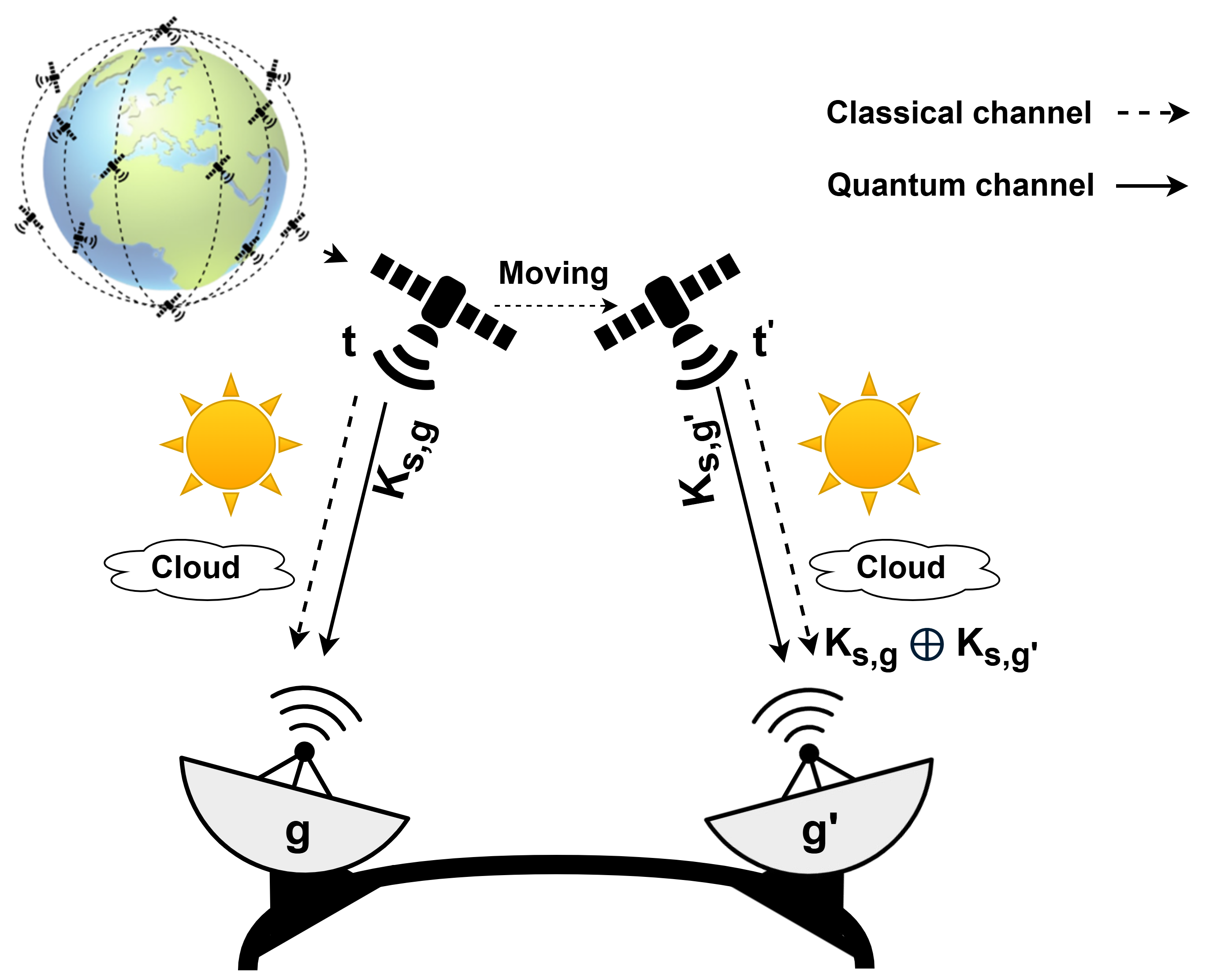
Satellite-based Quantum Key Distribution network connecting geographically separated ground stations.
Motivation
As quantum computers continue to advance, many widely used cryptographic techniques may become vulnerable to future attacks. Quantum Key Distribution (QKD) provides a fundamentally secure method for distributing cryptographic keys based on the principles of quantum mechanics.
Satellite-based QKD extends secure communication across global distances where fiber-based QKD becomes impractical. However, efficiently distributing quantum keys over large satellite constellations introduces many computational challenges, including routing, scheduling, and resource allocation.
Research Overview
My research develops routing, scheduling, and network optimization algorithms for satellite-based Quantum Key Distribution (QKD) networks. The goal is to efficiently distribute quantum keys among geographically separated ground stations while addressing the challenges of limited satellite resources, dynamic network topology, and time-varying satellite visibility.
My earlier research focused on single-satellite QKD systems, where quantum keys are generated between ground stations through individual satellites. This work investigated efficient resource allocation and scheduling strategies to maximize quantum key generation while ensuring fair resource utilization among multiple communication requests.
Building on this foundation, my current research investigates large-scale satellite constellations that incorporate Inter-Satellite Links (ISLs). Unlike single-satellite systems, quantum keys can be forwarded through multiple satellites before reaching their destination, introducing new challenges in routing, scheduling, and network optimization.
I develop algorithms that determine efficient communication paths while considering satellite visibility, network connectivity, transmission loss, quantum key generation rates, and limited satellite resources. My research aims to improve the scalability, efficiency, and fairness of future global quantum communication networks.
Research Topics
- Satellite-Based Quantum Key Distribution (QKD)
- Quantum Communication Networks
- Routing Algorithms
- Scheduling Algorithms
- Resource Allocation
Selected Publications
Please see the Publications page for papers related to this research area.
Future Research Vision
My long-term research vision is to develop trustworthy and secure intelligent systems by combining advances in Artificial Intelligence and quantum communication technologies.
As healthcare increasingly depends on AI-driven decision support, protecting sensitive patient information throughout data collection, transmission, and analysis will become increasingly important. I am interested in exploring how quantum-secure communication can strengthen privacy and security for future AI-enabled healthcare systems while continuing to advance research in both machine learning and quantum communication.
Research Collaboration
I welcome collaborations with researchers, students, and industry partners interested in Machine Learning, Artificial Intelligence for Healthcare, Quantum Communication, and Satellite-Based Quantum Key Distribution.